
No Getting Around “Green”

I have often described green as a fast moving, irreversible trend that will only grow in strength with each new generation.

In fact, the word and name green - or greene, if you prefer the silent “e” - has been around for some time, one could even say for generations. To solve this little quiz, you may need help from an older or younger generation because the questions and answers range from pop culture of the 40’s to now. So, if you find yourself with some time to spare this holiday weekend and are willing to focus on colors other than red, white and blue, please enjoy.

Warning: Answers appear at bottom of the post, so don’t peek under the Big Green Question Mark.

The Green Culture Quiz

  1. Mean guy from Pennsylvania - __________ Greene
  2. West coast punkers of the 90’s – Green ______
  3. Mellow sounding unity advocate in 1972 - _____ Green
  4. Crime fighter and Kato’s buddy – Green _______
  5. TV westerns were a bonanza for him - ________ Greene
  6. Mid 60’s TV series featuring transplanted NYC couple – Green ___________
  7. Premier funny man of the 70’s - _________ Greene
  8. Baseball hall of famer _______ Greenberg
  9. 40’s and 50’s actor - ___________ Greenstreet
  10. Went home with Oscar in 1941 - _______ Green _____ ______ _______
  11. Justice League member and superhero – Green ___________
  12. They were eco before eco was cool – Green___________
  13. 70’s movie NOT a favorite of AARP - __________ Green
  14. Hitters nemesis in Boston – the Green ________________
  15. Acclaimed 1999 Tom Hanks movie – The Green __________
  16. Favorite breakfast food of Theodor Seuss Geisel – Green ______ ___ ______
  17. 1968 John Wayne film The Green ____________
  18. NFL rival of the Chicago Bears, the Green ______ __________
  19. Captain Kangaroo sidekick, Mr. Green ________
  20. Former Fed Chairman and economic guru ______ Green______
  21. Popular “chick flick” _________ Green __________

Answers appear below the Big Green Question Mark

Read the rest of this entry »

One of the busiest people in the packaging industry is JoAnn Hines with her numerous business operations and websites. Her newest venture is Packaging Launch, and I am pleased to be participating as one of her staff experts to help review new package designs as submitted by people in need of unbiased, and knowledgeable input.

I asked JoAnn for the opportunity to interview her so we could discuss Packaging Launch for the benefit of our ISP readers.

Voice your opinion on packaging design!

Get feedback on your new design

joann-hines-packaging-divaDS: Where did the rather unique Packaging Launch concept originate and can you please explain to us the valuable service it provides?

JH: PackagingLaunch.com came about for a variety of reasons.

1st: I get so many calls from people who need packaging help and really need to be pointed in the right direction. I wanted a professional, quick and efficient way to help them without having to spend a fortune.

2nd: So many people have disastrous packaging and they aren’t even aware how bad it really is. There needed to be a method of finding out that they have packaging problems before it’s too late.

3rd: This is the place to test a packaging concept if you are not sure before you invest heavily and have a packaging fiasco.

DS: Can anyone submit a package design for review and is there a cost?

JH: Yes, anyone can submit a package for review. However there must be a professional photo to submit on the site. The experts need to be able to evaluate the package and they need a quality image to do so.

There is a nominal fee of $250 for posting the photo (which includes a live link and a product description). This is far less that a single expert’s time and provides you with insights from a variety of packaging experts.

DS: Are there any ground rules for the expert reviewers? Read the rest of this entry »

Recently on this blog we published a post applauding mega retailer Home Depot for going above and beyond in their garden department by making it easy for their customers to return their empty polystyrene floral containers. They could have decided their responsibility ended at the cash register but opted to assume some level of responsibility after the sale.

If we praise effort like Home Depot’s, we also have to condemn a retailer like Sears who is most definitely guilty of promoting a product for its green benefits; in this case a zero emission, propane powered lawn trimmer, and failing to assume the post sale responsibility that is certainly theirs.

Are Propane Powered Garden Tools Really Green?

The Green Product

The Green Product

For my Father’s Day gift, my wife and I went shopping for a propane powered weed trimmer/cutter. I personally dislike the fumes and trouble of a gas powered weed whacker, and have grown to dislike my electric and battery powered units as well. I realize $200 for a propane model is a lot of money at times like this, especially when you can buy an inexpensive electric version for as little as $39.00. However, I decided that the eco benefits would make it worth the higher initial cost.

The problems really started when I realized the propane fuel tanks my new trimmer would use are not refillable. So I asked a friendly Sears employee about recycling and disposal. The propane tanks are metal so if not refillable, certainly they have to be recyclable, right? The minimal information provided indicated each tank lasts approximately two hours so it did not take a mathematician or landscaper to determine I was likely to create an empty cylinder every other week or ten to twelve cylinders over the course of a single Chicago summer. I was surprised when the man offering “trained Sears’s assistance” said he had no idea about disposal or recycling. I guess that was not covered in sales training class.

The Search for Information and Eco Truth

The Green Pitch

The Green Pitch

We bought the trimmer and the next morning I called our local waste hauler, Waste Management, and asked about the recycling of the empty propane tanks, in hope recycling could be accomplished curbside. They promptly responded they did not want them and have always instructed their people to not collect them.

Recalling we do business with a company for propane for our fork lift, I thought they might have some answers. They were kind enough to tell me that they would accept one or two empty tanks but did not want to be a collection point since the small, empty canisters I was eager to get rid of had no value, only cost to them.

I turned to our local village for assistance and they quickly sent me to a county department in charge of hazardous waste. The lady who answered the phone immediately understood the problem and told me I was the fourth call that day on the same topic. She admitted her family used a similar propane cylinder for cooking while camping but told me they (county government) could not accept the cylinders because they were not considered hazardous. “What do you do with yours?” I naively asked. “I bury and hide them in my kitchen garbage bags” she replied, “Otherwise our waste hauler won’t take them.” Read the rest of this entry »

I am very happy to announce I am now blogging for Packaging Digest, one of the media leaders covering the packaging industry. Writing for them is a terrific opportunity to reach a different, substantially larger audience and I invite and encourage you to check out their excellent online and print publications.

The Increasingly Crowded Green Blogosphere

The world of eco focused internet blogging has become very crowded as more people and companies are writing about packaging OR about sustainability. Green is an increasingly popular topic because readers are eager to better understand sustainability. Packaging will always be a green focal point for consumers so the growth in interest is to be expected.

packaging-digest-logoIn our work as well as in our writing, we strive to be a place where people with an interest in sustainability AND in packaging can learn more about the people and products impacting both.

That is our overall objective on Inside Sustainable Packaging and will be our goal for Common Sense and Sustainability, our new featured blog on Packaging Digest. Read the rest of this entry »

  • 0 Comments
  • Filed under: Salazar News
  • Though the above title may sound like yet another edition of the Star Wars series, this post is actually about the number of very good companies that are now producing “stock” molded pulp products. In the past the words stock and pulp were never used in the same sentence unless you were talking about egg cartons or soft drink carriers but the number of companies offering standard, “no tooling required” packaging solutions is growing quickly.

    Eco Flex Molded Pulp and Beyond

    Five weeks ago we launched this new green product which is very unique in that it is flexible molded pulp able to be bent, folded, rolled and easily hand torn to size, making it ideal for a multitude of packaging applications. We still love our new Eco Flex molded pulp product but we also realize that in some situations, an application specific form fitting molded product may be better for the customer and application.

    molded-pulp-packaging-for-bottlesMolded pulp in any shape or form is 100% recycled content, usually newspaper PCW and it is also “obviously” green. We believe the clarity of that green message is becoming more and more important and quite frankly, very few products fall into that category of being undisputedly green. There is often debate on almost any imaginable packaging product one could offer or use, but I have never heard two green minded individuals argue over the merits of molded pulp packaging.

    Where’s the Adventure in Stock Molded Pulp Packaging

    The adventure comes from a manufacturer guessing at what sizes customers could potentially want and making a substantial investment in a mold to create it. In all honestly, it is usually not as wild of a guess as it may appear because there may be a customer or two with ready business that take some of the risk out of the decision.

    In many industries, there are indeed common or standard sizes that often repeat. In the glass jar and candle businesses for example, it is not at all unusual to see 1”, 2” 3” and 4” diameter candles and standard wine bottles tend to have the same shape and size. Tooling can also get very creative so that a single cavity may be able to accommodate various diameters of products.

    How Does This Impact Your Green Packaging Efforts? Read the rest of this entry »

    One Year - More than 100 Posts!

    It is hard to believe but it was one year ago today that we launched our blog at the urging and advice of our marketing guru, Brad Shorr.  I admit initially being somewhat reluctant, or as others recall, “dead set against it” because I was concerned we would not have enough interesting topics to write about, or be able to maintain an audience. Boy was I wrong.

    In the last 12 months Brad and I have posted over 100 articles, conducted 7 interviews, launched 11 new green packaging products and irritated at least 23 people in the packaging industry and probably twice that many in the green community. We have freely shared our opinions and perspectives, even when they are not the popular thought and we have enjoyed it tremendously.

    Quick Recognition from within the Packaging Industry

    Last August after publishing ISP for just a few short months, we were surprised when David Bellm of Packaging Digest, a packaging industry leading publication, talked about Inside Sustainable Packaging on his blog.

    It was high praise from THE premier packaging blog and it told us we are on the right track. Our initial objective was to deliver worthwhile, valuable content to our readers while informing them on the new products and activities within our company. Keeping that balance was the key and we must walk that fine line well because Packaging Digest has invited me to join their team of packaging bloggers.

    Is Inside Sustainable Packaging Self Promoting? Read the rest of this entry »

  • 4 Comments
  • Filed under: Salazar News
  • printed-water-activated-tapes

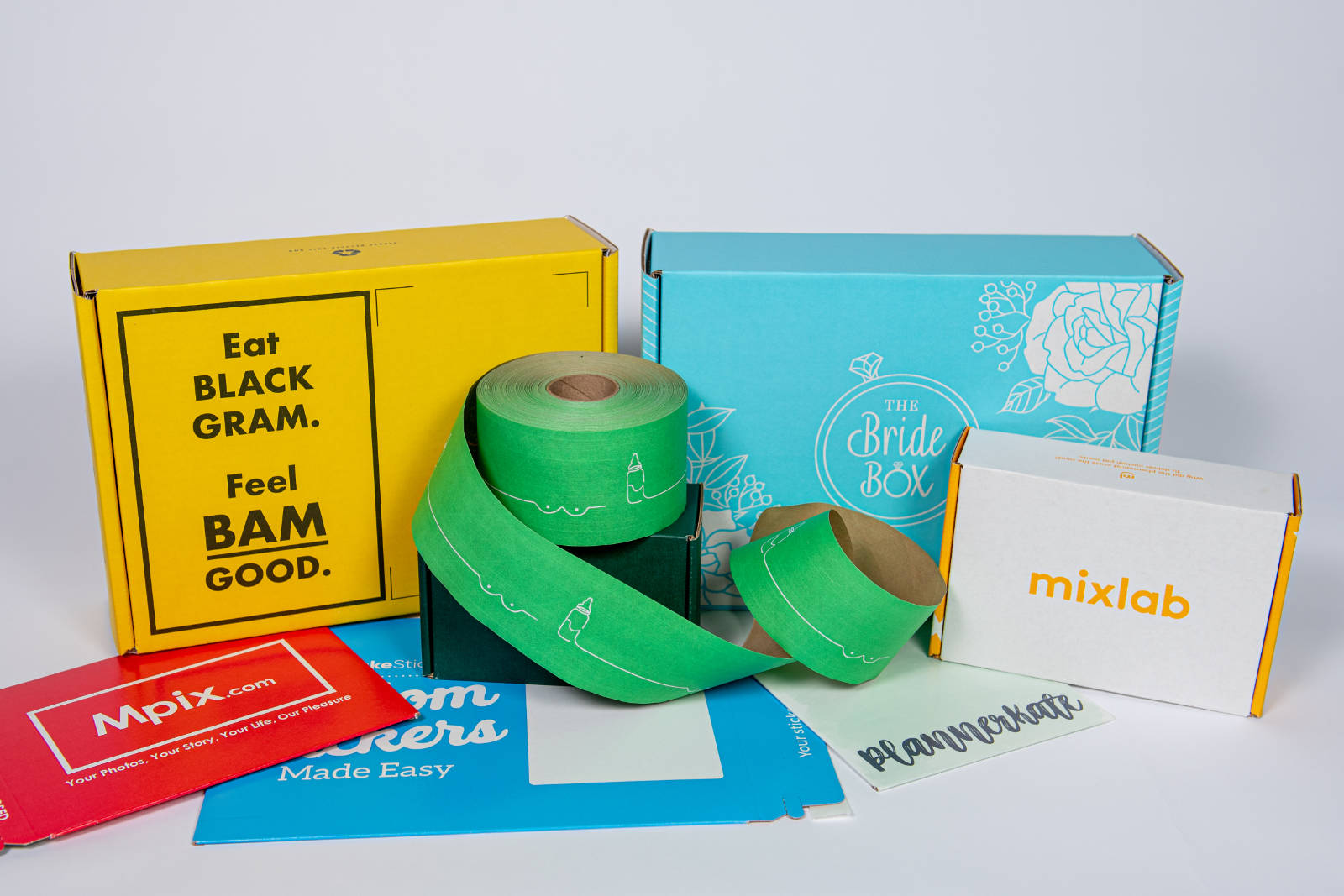
    What do a West Coast oyster farm, a Wisconsin maker of fine cutting tools, a creative designer of green products for the office and unique online green products store, all have in common? They all decided to combine unprinted boxes with custom printed tape to -

    • Communicate their green brands
    • Make their secondary packaging as eco friendly as possible
    • Reduce their packaging costs

    FREE machine for new printed tape customers. Contact for details.

    FREE machine for new printed tape customers. Contact for details.

    The Benefits of Printed Water Activated Tape

    • It is colorful, stands out and your customers remember your message, logo, and brand
    • It is a much less expensive branding alternative to costly custom printed boxes
    • It has a high green perception rating from even casual observers and customers
    • It’s a paper product so no stripping of plastic tape is necessary before recycling the corrugated box
    • It bonds better to the box making it safer, more rigid and much more secure because it prevents tampering and pilferage

    Sustainable Packaging Is Creative?

    Yes it can be.  Take a look at what these terrific customers decided to do to convey a consistent and memorable image. Read the rest of this entry »

    In an unprecedented move, the Globe Guard Eco Consistency Award judges held a first ever midyear caucus and by unanimous vote decided to give Home Depot this prestigious award. OK, that all sounds quite impressive but the fact is that my wife took me shopping for the seasonal purchase of flowers for her garden and I spotted this sign.

    home-depot-plsatics-recycling-program

    That is when I realized Home Depot has launched an excellent, green program to encourage and facilitate the return of the empty flower containers they now sell.

    Polystyrene - The Plastic Even Waste Management Doesn’t Want

    What makes this move by Home Depot award worthy is that most flower pot containers are made of polystyrene (Recycled code #6). Most of us know polystyrene as the foam looking plastic material often used for takeout or left over containers, some “foam” drinking cups and some loose fill packaging materials shaped like shells or peanuts. That happens to be reason #42 why I hate foam peanuts, but that is a sore subject and a different blog post.

    I am not sure why most floral containers are made of styrene but I am willing to bet it is about cost. Polystyrene can easily be blended with just about any plastic or near plastic trash and is able to be formed into the trays and pots we all take home, empty and discard. What I am certain of is that in our suburban Chicago curbside recycling service provided by Waste Management, is very clear to point out they will NOT take back anything with a #6 recycled code which includes any form or type of polystyrene. Read the rest of this entry »

    People who are eager to find quick and simple solutions to some of our most complex sustainability problems are often disappointed when they hear me say there is no packaging magic bullet that satisfies all requirements, at all times, and on all products.

    In fact, I would go so far as to say that rarely does one product do everything that is necessary for a tough application. If there is a “universal solution” to our eco dilemma, it is probably multiple products and resources working together, each bringing something unique, different and green to the application.

    One Tough Green Packaging Application

    bad-axe-eco-friendly-packagingSay hello to Bad Axe Tool Works, a company with a neat name, interesting web site and a premier manufacturer of cutting tools for woodworking and other wood related activities like pruning and clearing trees. When we met them they were concerned with preventing damage during shipment and making sure their packaging was as green as possible. Considering the incredibly sharp nature of their products, it was definitely a challenge.

    One Great, Excellent Packaging Partner

    Adams Foam in Chicago makes a terrific product called Green Cell Foam. The product is made from non-GMO corn, and after use, it can be recycled, composted or simply dissolved in water. It is also surprisingly tough and able to stand up to rugged applications like the one that was developing at Bad Axe Tools Works. We had conversations with the nice people at Adams Foam but nothing brings packaging people together like a good, challenging application and Bad Axe did indeed bring us together.

    What it Took to Get the Job Done (See Photos Below) Read the rest of this entry »

    eco-friendly-corrugated-mailers-lid-open

    They are known by many names including literature mailers, tuck and fold mailers, shipper boxes and even pizza boxes, but the corrugated die cut mailer is making a big comeback and guess what? It is greener and no longer white.

    What Makes These Corrugated Mailers Greener?

    In the past, virgin board was used to make these versatile shipping and storage containers but today we are making them out of recycled corrugated materials. More importantly they are being made out of 100% recycled material which means they cannot be white on the outside. Many people don’t realize it but when you give a box a white exterior, that outer layer (usually 1/3 of the overall board content) has to be virgin. If you want it white on the inside too, then 2/3 of the corrugated content must be made from virgin fibers. Remember our motto, a virgin fiber is a terrible thing to waste, especially when it is not necessary.

    Why Have Die Cut Mailers Been Historically White

    The theory was that they looked better, cleaner, nicer, etc. There is no argument about that when the product is shipped … but have you ever seen one of those mailers when it arrives at its intended destination? Whether is ships via FedEx, UPS or USPS, the mailer no longer looks pristine or white upon arrival. Typically it is dirty, scuffed and even covered with fingerprints. The white outer layer looks great when it is shipped but the appearance rapidly degenerates as soon as it leaves the shipper’s facility.

    What Makes These Corrugated Mailers Better? Read the rest of this entry »

    Follow Globe Guard on Twitter

    Subscribe via RSS
    in a reader

    Enter your email address:

    Delivered by FeedBurner

    Inside Sustainable Packaging Blog - Salazar Packaging

    Recent Comments

    • Dennis Salazar Chris, thank you so much for sharing this possible solution and I am going to check it out myself. It really irks me however that consumers like you and me have to come up with our...
    • Chris Saw your blog post while considering one of these myself. I haven’t tried it, but this looks very promising: http://www.amazon.com/Mac-Coup ler-Propane-2-99-shipping/dp/B 000SALJEI Chris
    • Dennis Salazar Thank you Meridith and I will take a closer look at the option Coleman is suggesting. When I spoke to Waste Management, I did not get the impression they wanted to deal with the...
    • Meredith Hi Dennis - very interesting post, I had no idea. I agree, Sears could really take advantage of this opportunity. I did a quick search on the Coleman website, and found this information...
    • Dennis Salazar Rider, we are fortunate to have the freindship and guidance of a green blogging pioneer like you. Thank you for the nice response and for showing us the way.